
Executive summary
For the analyst and the principal, in four lines.
The structural limitation of small-scale farming is a primary barrier to institutional entry, as the fragmentation of millions of farms working less than five hectares prevents the rigorous contracting, monitoring, and auditing required for large-scale investment.
Systemic risks in global agriculture often stem from a lack of mechanisation and professional oversight at the origin, where manual production on unsuitable terrain makes it impossible for institutional buyers to verify yield or ensure a consistent supply chain.
Institutional-grade assets require the elimination of meteorological and structural instability by moving away from fragmented production toward consolidated operations that can provide continuous, timestamped data and a documented, auditable route to market.
The significant scale of current institutional farmland management, with leading firms overseeing billions in assets, underscores the necessity for professional management at scale and the standardisation of agricultural assets into a format comparable to infrastructure investments.
Why does institutional capital treat most farmland as uninvestable
Because the production base cannot be contracted, measured or audited. Global demand for food and industrial raw materials has scaled continuously, but the supply side in most permanent crops has not consolidated with it. The obstacle an allocator meets is rarely biological. It is structural.
Eurostat counted 10.3 million farms across the European Union in its farm structure survey, two thirds of them working less than five hectares. Ownership at that granularity produces four failure modes that a risk committee recognises immediately from other asset classes.
Generational division of title means a single commercial block is assembled from dozens of counterparties, each with independent incentives and no obligation to invest capital. Absentee ownership is common, and capital expenditure on replanting, drainage or machinery is the first thing deferred.
Most of the small farms have no standardized data. Reporting is anecdotal and retrospective. There is no continuous record of soil condition, canopy development, water use or input application, so there is nothing to audit and no baseline against which variance can be measured.
Managing and making decisions is on “as possible” basis. Harvest timing follows seasonal labour availability rather than biological maturity. Fertiliser and plant protection are applied uniformly across plots with materially different soils, which raises cost and depresses yield at the same time.
Output is sold through brokers into a residual market at whatever price clears in that week, with no forward visibility for either the grower or the buyer.
An allocator underwriting infrastructure or real estate expects single control of the asset, instrumented performance data, a professional operator and a contractual route to revenue. Legacy farming offers none of these. The asset can be excellent and still be uninvestable.
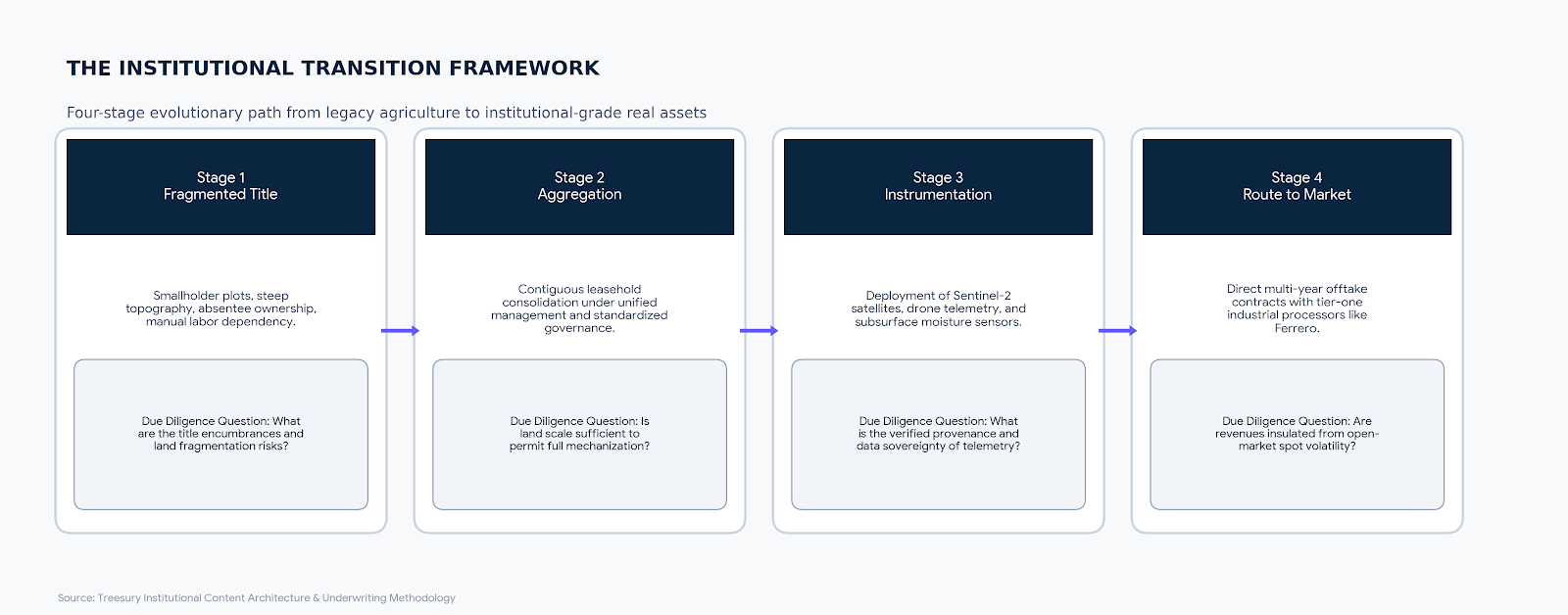
We identified 4 stages of transforming of legacy agriculture to institutional grade real assets
What does the hazelnut market show about the cost of fragmentation
Fragmentation of hazelnut farms at origin transmits directly into the balance sheets of investment grade buyers. Hazelnuts are the most concentrated major tree nut in the world, and 2025 demonstrated what that concentration costs when the weather turns.
Resources report that Turkiye produces on the order of 450,000- 900,000 tonnes a year (600,000–700,000 as reported by Economy insights and avg 600,000-700,000 as reported by CropGPT), which is close to 60% of global output. Driven by 550,000 aging smallholders (avg. 58–59), the national farm sector is trapped in low-yield, unmechanized sub-hectare plots on steep slopes, compounded by >45% capital costs. Typical holdings run to one or two hectares on Black Sea hillsides where mechanised harvest is not physically possible. There is no consolidated operator to hedge, no aggregate yield model, and no way to verify a crop before it is in the shed.
Spring frost in 2025 cut that crop to approximately 518,000 tonnes. FreshPlaza reported Turkish hazelnut prices up 125% as the crop fell. CropGPT reported that the yield dropped from 708,000 t in 2024 to 453,000 t in 2025, resulting in only 1.03 t/ha.v EastFruit reported that Turkey raised its state purchase price by more than 50% into the supply shock. Bloomberg Law then reported that Ferrero, the world’s largest hazelnut buyer, would cut Turkish purchases after the price surge.
The correction was as sharp as the shock. Industry estimates for the 2026 and 2027 Turkish crop have run between roughly 805,000 and 829,000 tonnes across the season, with global supply estimated near 1.59 million tonnes against roughly 1.24 million tonnes the prior year, according to the Helios Ingredients market update of August 2026. A buyer planning a decade of confectionery volume cannot build a procurement strategy on a supply base that moves by 55% in a single year for meteorological reasons.
The industrial response has been to sponsor supply outside the fragmented origin. Ferrero runs Progetto Nocciola Italia through its Ferrero Hazelnut Company to expand Italian plantings, and trade press including Global AgInvesting has reported Ferrero plans for hazelnut production in Serbia. This is market context and nothing more. It describes why demand for consolidated, plannable origin exists. It is not a commercial arrangement held by Treesury, and by design no advance sales contracts are finalised for the new orchard.
What are the tests an orchard has to pass to be institutional grade
There are 6 tests, and they are the same tests an infrastructure asset faces. Contiguity and topography, data governance, harvest execution, labour dependency, route to market, and whether the asset can be reported and benchmarked at all. The table below sets the legacy position against the institutional one.
| Test | Legacy smallholder model | Institutional standard |
|---|---|---|
| Land and topography | Fragmented plots, frequently under two hectares, on slopes that preclude machinery | Contiguous blocks under single management on graded, trafficable ground |
| Control of title | Dozens of owners, generational division, absentee holders | One operator with secured tenure over the whole block, ownership or long lease disclosed |
| Data governance | Anecdotal, retrospective, no continuous record | Continuous soil, canopy and water telemetry, time stamped and auditable |
| Harvest execution | Manual picking, timed to labour availability | Mechanised sweeping and collection, timed to biological maturity |
| Route to market | Spot brokerage into a residual market | A documented commercial strategy, with contracted and uncontracted volume stated separately |
| Reporting | None. Nothing to audit, nothing to benchmark | Projected against actual, published including the misses, benchmarkable to a real asset index |
The reporting row is the one most often skipped and the one an allocator reaches first. An asset that cannot be benchmarked cannot be sized inside a portfolio. NCREIF publishes a Farmland Property Index that separates annual cropland from permanent cropland precisely because the two behave differently, and permanent crops carry a long establishment period before any income appears. An orchard that cannot report into that shape is not a candidate, however good the trees are.
When institutional capital enters permanent crops, it buys into structured exposure to productive real-world assets rather than underlying land ownership.
The answer is operated assets with a professional agronomy layer, not land alone. The distinction matters, because permanent crops are an operating business attached to a piece of ground rather than a lease over it.
Nuveen Natural Capital reported 12.1 billion dollars of farmland assets under management, more than 2 million gross acres, 116 employees and exposure across eight geographies and more than 60 crop types, all as at 31 December 2025. Pensions and Investments ranked it the largest farmland manager worldwide as at 30 June 2025. That headcount figure is the informative one. Institutional farmland ownership is staffed like an operating company because the return comes from operating decisions.
The direction of travel in the sector has been toward permanent crops, where the operational premium is largest. Global AgInvesting reported Manulife acquiring two permanent cropping assets exceeding 1,400 acres in Fresno, California. In the United States, the same consolidation logic already reshaped almonds and pistachios, and it is now visible in hazelnuts. Pacific Nut Producer reported in April 2026 that Oregon growers achieved the first crop above 100,000 tons, produced on flat Willamette Valley ground with full mechanisation, from an industry a fraction of Turkey’s size by grower count.
That is the whole argument in one comparison. The same crop, grown by half a million smallholders on slopes, is uninvestable. Grown by a few hundred consolidated operators on graded ground with machinery and records, it is an asset class.
Where does Treesury sit against these tests
Partially proven and openly labelled. What follows is separated by evidence tier, because mixing the tiers is the fastest way for an allocator to stop reading.
Tier 1, audited and actual, these orchards
One completed offering. The pilot raised the equivalent of 1.5 million euro and planted 53 hectares, subscribed by more than 120 investors from three continents.
Approximately 106 hectares held under a 40 year lease at Maca Humka, cadastral municipality of Čoka, Serbia, roughly 198 kilometres from Belgrade on the flat Vojvodina plain. The land is leased, not owned.
Planting is phased. Phase one ran October 2025 to May 2026 using two year old certified saplings. Phase two runs October 2026 to May 2027 using three year old saplings. Varieties are Corylus avellana, specifically Tonda di Giffoni, Tonda Gentile Romana, Nocchione and Tonda Gentile delle Langhe.
Establishment density is 667 saplings per hectare, thinned to 333 per hectare by year seven. That thinning schedule is a mechanisation decision as much as an agronomic one, because it sets the machinery corridor width for the following 33 years.
Manager co-investment is contractual rather than rhetorical. The issuer acquires one token per hazelnut tree it self funds, to be completed by 31 May 2027.
Tier 2, comparable operating data, not from these orchards
Aleksandar Petrović, Chief Agricultural Officer, has 25+ years of experience in hazelnut cultivation, established the first modern hazelnut plantation for Ferrero in the Balkans in 2004, leads a team of 12 agronomists and has supported the planting of more than 10,000 hectares. This is real operating history, on other people’s trees.
BioSense Institute in Novi Sad, an EU Centre of Excellence for information technology in agriculture, co-developed the production technology model and supplies the AgroSense platform and the Plant-O-Meter device, together with support on soil and carbon dioxide certification. The European Investment Bank financed its new research building, opened in 2023.
Institutional corroboration comes from the Katapult Accelerator, which is funded by the World Bank and the European Union, the Serbian Innovation Fund drawing on European Union pre-accession funds, and EBRD StarVenture. None of these is a return guarantee and none is a direct funder of the orchard.
Tier 3, forecast, assumptions exposed
The white paper yield schedule shows nothing in years one to three, then 333.5 kilograms per hectare in year four, rising through 1,667.5 in year six and 2,668 in year seven, to 4,002 kilograms per hectare from year nine onward. Every figure in that sentence is a forecast based on previous experience and trial results.
First payouts are projected for March 2033, tied to the prior calendar year harvest. Orchard profitability is expected once trees reach six years old, from sale of the 2032 crop.
Returns are production dependent. Investors would be paid from the yield of the specific orchard funded, not from company profits, and total loss of principal is possible.
On route to market, the position is deliberately incomplete. No advance sales contracts are finalised for the new orchard, because finalising them early would create immediate obligations to buyers before the crop exists. Ferrero, Nestlé and Loacker appear in the white paper as potential future buyers. None is a contracted counterparty for this particular orchard. Ferrero has a decade long direct presence in Serbia and a strategic partnership with the Serbian Ministry of Agriculture, and holds contracts on experimental orchards elsewhere. That is market context and track record, not secured demand.
Carbon sits outside the return case by design. Sequestration is estimated at roughly 158 kilograms of carbon dioxide per tree per year, and credits would trade on the voluntary market, where prices are neither administered nor assured. The investment case has to stand with carbon valued at zero, and it is written that way.
What this framework does not tell you
Four things, and each of them is a different screening question.
It does not describe what an investor can enforce. Contiguity, telemetry and machinery are asset quality. Ranking, recourse, valuation policy, manager insolvency and named service providers are governance, and they are answered separately.
It does not prove returns. There are no audited returns on these trees and there cannot be yet, because the yield schedule shows zero kilograms in years one to three. Any allocator asking for audited operating performance on this orchard should be told plainly that it does not exist.
While our proprietary growth methodology makes plants more resilient, it only somewhat offsets the weather risk, it does not completely remove it. Mechanisation removes labour dependency. Telemetry shortens reaction time. Neither prevents a frost event of the kind that took a third of the Turkish crop in 2025. Insurance covering weather, fire, theft, third party damage and average yield is planned, and will be finalised only after the orchard and infrastructure are established.
Frequently asked questions
Is investable agriculture just a description of large farms?+
No. Scale is necessary and not sufficient. A large farm with no continuous data, standardized operations, documented route to market and no reporting discipline fails the same due diligence as a small one. The distinguishing feature is auditability, not hectares.
Does mechanisation actually change the risk profile, or only the cost base?+
Both, but unevenly. It removes the dependency on seasonal labour availability, which is a real and recurring operational risk in fragmented origins, and it decouples harvest timing from labour supply so that picking follows maturity. It does not touch weather, disease or price risk.
Why does the absence of offtake contracts not disqualify the asset?+
Because it is a disclosed commercial choice rather than a failure to sell. Contracting a crop that does not yet exist creates delivery obligations against yield that hasn't matured yet. The honest position is that demand for hazelnuts is structural and buyer relationships in the region are long standing, and that neither of those is a contract. We avoid signing contracts before we are positive that we can fund orchards at scale which will allow us to negotiate preferential terms. An allocator can price that. What an allocator cannot price is an implied contract that turns out not to exist.
How should the Tier 2 operating history be weighted?+
As evidence of method, not of outcome on this asset. Twenty five years and more than 10,000 hectares supported tells you the agronomic approach has been executed repeatedly at scale. We also include 150+ ha of our R&D fields, that grow in similar region. It says nothing about the yield of the trees at Čoka, which have not yet produced.
What would move this from Tier 3 to Tier 1?+
Time and published variance. Establishment cost against budget, sapling survival rates, canopy development against plan, and eventually harvested kilograms per hectare against the forecast schedule, published including the years that miss.
References
- Eurostat, Farm structure survey 2016, news release 105/2018, 28 June 2018. Of the 10.3 million farms in the European Union, two thirds are less than five hectares.
- Economy Insights, Turkey’s Hazelnut Stronghold. Turkish output near 650,000 tonnes a year, close to 60 to 70 percent of global production, and approximately 550,000 of the world’s roughly 600,000 hazelnut growers.
- Helios Ingredients, Hazelnut Market Update, August 2026. Turkish crop of approximately 518,000 tonnes in the frost affected 2025 and 2026 season, estimates between approximately 805,000 and 829,000 tonnes for 2026 and 2027, global supply near 1.59 million tonnes against roughly 1.24 million tonnes.
- FreshPlaza, Turkey hazelnut prices up 121% as crop falls, 2025.
- EastFruit, Türkiye raises hazelnut purchase price by over 50% amid looming supply shock, 2025.
- Bloomberg Law, Ferrero to Cut Turkish Hazelnut Purchases After Price Surge.
- Nuveen Natural Capital, Global farmland capabilities. 12.1 billion dollars of farmland assets under management, more than 2 million gross acres, 116 employees, eight geographies and more than 60 crop types, as at 31 December 2025. Ranked number one farmland manager worldwide by Pensions and Investments as at 30 June 2025.
- Global AgInvesting, Manulife Acquires Two Permanent Cropping Assets Exceeding 1,400 Ac. in Fresno, CA.
- Pacific Nut Producer, Hazelnut Growers Achieve First-Ever 100,000+ Ton Crop, 3 April 2026.
- Global AgInvesting, Italy’s Ferrero Plans Hazelnut Production in Serbia. See also Progetto Nocciola Italia, Ferrero Hazelnut Company.
- NCREIF, Farmland Property Index, which reports annual cropland and permanent cropland separately.
- European Investment Bank, New BioSense Institute building opens for scientists and startups, 2023.
- Treesury White Paper, second security token offering, sections 1, 3, 5, 6, 7 and 10. Governed by the Law on Digital Assets of the Republic of Serbia, Official Gazette number 153/2020. Yield schedule, planting phases, lease terms, team credentials, buyer position and risk factors are drawn from this document. The white paper notes that third party market figures within it were not independently verified by the issuer.
by Treesury Investment Team