
Executive summary
For the analyst and the principal, in four lines.
A single, fragile corridor in northern Turkey accounts for nearly 70% of global hazelnut production. For the world’s largest food and confectionery conglomerates, this geographic monopoly represents an escalating supply-chain hazard. As climate volatility triggers erratic spring frosts and legacy orchards grapple with aging trees, absentee ownership, and acute seasonal labor shortages, industrial procurement heads are facing a structural deficit. With the global hazelnut market projected to surge from $16.52 billion in 2025 to $18.07 billion in 2026 and is expected to grow to $25.58 billion in 2030 at a compound annual growth rate (CAGR) of 9.1% corporate buyers can no longer rely on legacy smallholders. Institutional capital is stepping in to build modern, mechanized production hubs across Southeast Europe to secure essential supply lines.
A Monopoly on Steep Terrain
For decades, global confectionery giants have quietly managed one of the most concentrated raw-material risks in modern agriculture. Unlike annual row crops like corn or soybeans, which shift across hemispheres in response to price signals, hazelnuts are tethered to geography and time. Over two-thirds of global export volume originates along a narrow, precipitous strip of Turkey’s Black Sea coast.
Legacy production in Turkey cannot support modern operational standards. The vast majority of Turkish orchards are small, multi-generational family plots carved into steep hillsides where tractors cannot operate. The Black Sea region relies primarily on traditional cultivars such as 'Tombul' and 'Palaz'. Farmers cultivate these varieties using the "ocak" system—a multi-stem shrub formation rooted into precipitous mountain slopes. This physical architecture is entirely obsolete. The rootstocks suffer from advanced age, while the steep regional topography prevents any viable mechanization. Furthermore, an aging farmer demographic accelerates the decline in basic orchard maintenance. The 2022 data on water footprint in the Çarşamba district of Samsun province, Türkiyehazelnut farmers (72.3%) used no irrigation, 24% used furrow irrigation, and 3.6% adopted the pressured irrigation systems.
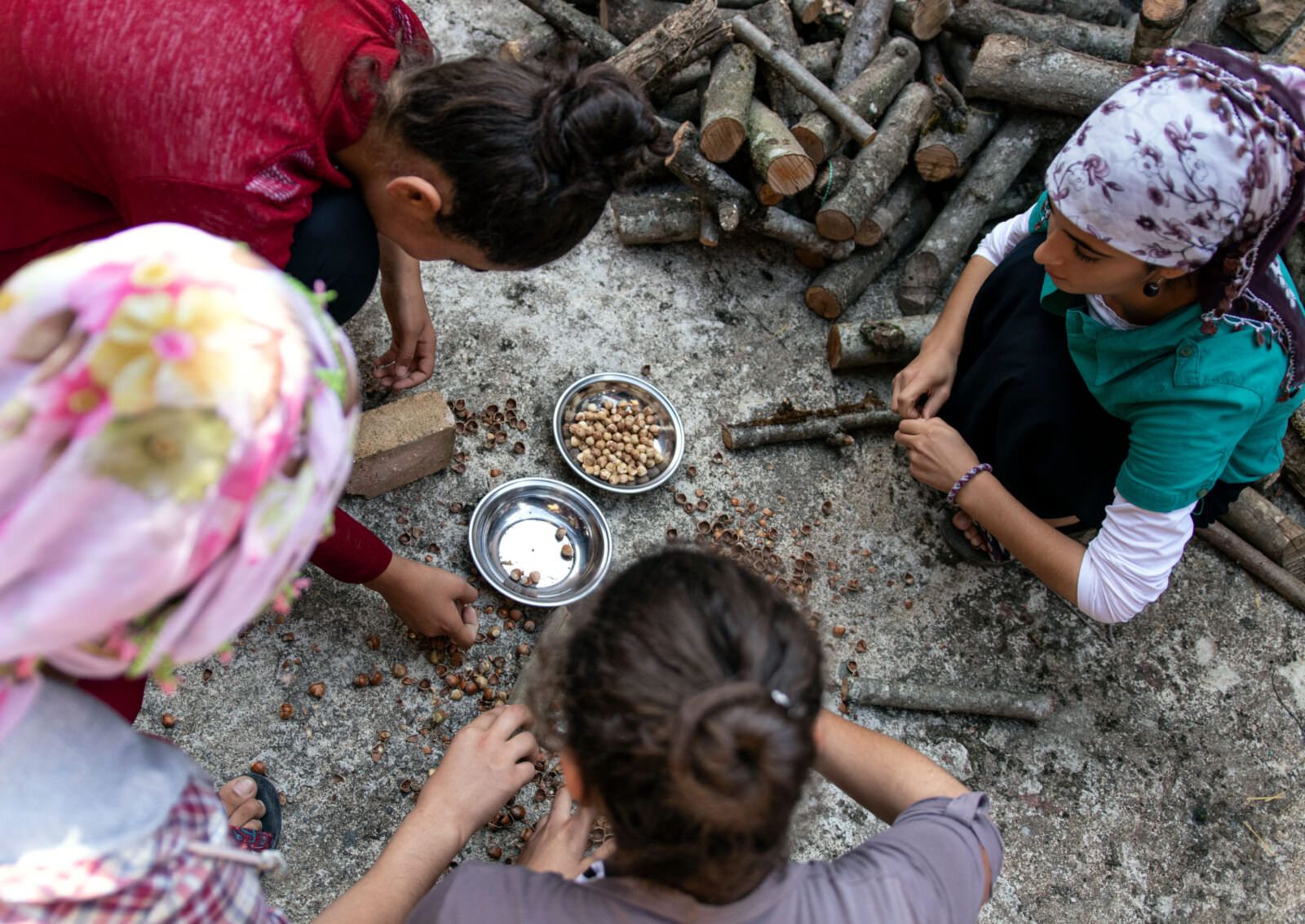
Harvest season compresses into a frantic four-week window across August and September, relying almost entirely on tens of thousands of seasonal migrant workers. Add increasingly erratic microclimates, where unseasonal spring warm spells trigger premature flowering, followed by devastating late frosts, and localized weather events routinely send shockwaves through global commodity pricing.
For corporate treasuries, the question is no longer whether the Black Sea will experience another supply disruption, but how much margin erosion they can endure before establishing alternative supply chains.
The Inelastic Appetite
The urgency behind supply diversification is fueled by unrelenting demand. For example, in 2025, due to severe spring frosts in April, a drop in harvest output was projected to 453,000 tons, down from 717,000 tons in 2024 (37%). Additionally, the Turkish Grain Board has announced a 50% increase in the base price paid to farmers for their hazelnuts.
In industrial food manufacturing, hazelnuts are virtually non-substitutable. With a lipid content averaging 60.5% and high concentrations of oleic acid, the nut provides unique rheological properties, melting profiles, and flavor characteristics that define benchmark confectionery formulations. Reformulating a core consumer product to reduce hazelnut content compromises texture and risks consumer backlash.
Industrial procurement teams cannot simply scale back purchasing. Faced with locked-in recipes and expanding retail commitments, corporate buyers are forced to compete for limited spot volumes whenever legacy harvests fall short. The resulting price volatility turns procurement into a high-stakes balance sheet risk.
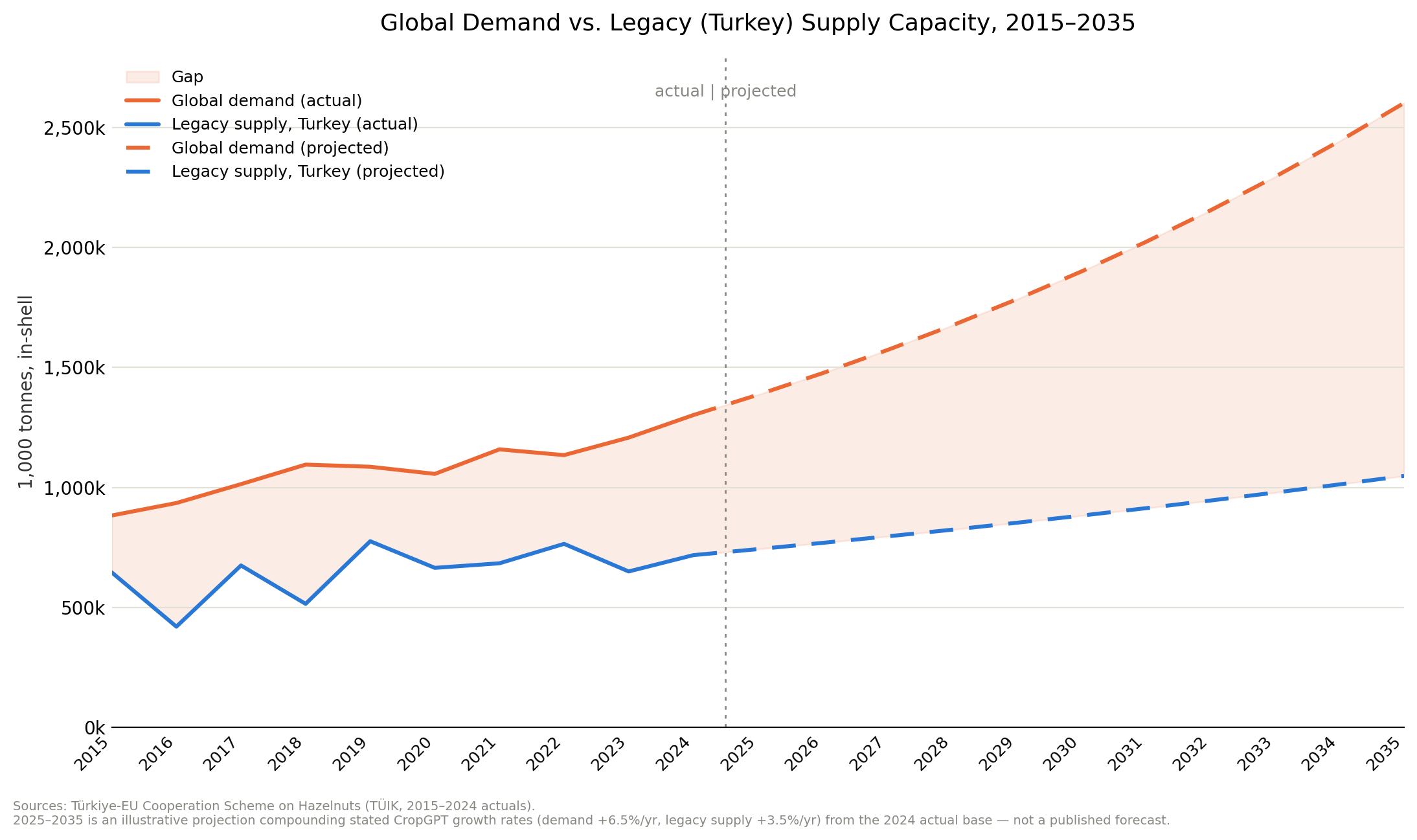
Global hazelnut demand has risen steadily over the past decade, from roughly 883,000 tonnes in 2015 to 1.3 million tonnes in 2024, while Turkey, the world's dominant single-origin supplier, has produced a volatile and largely flat-to-modest range between 420,000 and 776,000 tonnes over the same period. The chart extends both trends to 2035 using compounding growth rates published in industry commentary (roughly 6.5% annual demand growth against 3.5% annual growth in Turkey's legacy production capacity), illustrating the widening gap between global consumption and the capacity of the world's largest producer if new supply does not come online. Disclaimer The 2015 to 2024 figures in this chart are sourced from official Turkish Statistical Institute (TÜİK) data published through the Türkiye-EU Cooperation Scheme on Hazelnuts. The 2025 to 2035 figures are an illustrative projection, not a published forecast. They are calculated by compounding two growth-rate assumptions cited in third-party industry commentary from the projection's 2024 base year, and do not account for new orchard plantings, non-Turkish supply growth, weather variability, or other factors that could materially change future production and consumption. This chart is provided for general informational and illustrative purposes only and should not be relied upon for investment, business, or financial decisions.
Engineering the Modern Orchard
Solving this structural bottleneck requires breaking the physical limitations of legacy farming. Southeast Europe, specifically the fertile plains of the Pannonian Basin, has emerged as the premier corridor for institutional-grade diversification. The region shares the optimal latitude and climatic envelope of the Mediterranean basin but offers flat, contiguous arable land suitable for full-scale industrialization.
The difference between a traditional smallholder plot and an institutional orchard is rooted in engineering:
| Metric | Legacy Production (Black Sea) | Modern Orchard |
|---|---|---|
| Topography & Layout | Steep hillsides, fragmented plots | Contiguous, laser-graded acreage |
| Cultivation & Monitoring | Manual labor, qualitative scouting, approx 10p/ha | Sensor arrays, drone telemetry, approx 2p/100ha |
| Harvest Execution | Manual hand-picking, migrant labor | Autonomous, mechanized sweepers |
| Risk Architecture | Unhedged weather & labor shocks | Direct corporate offtake formulas |
By replacing manual labor with mechanical harvesters and deploying precision sensor telemetry to manage irrigation and soil chemistry, modern operators eliminate the yield unpredictability that plagues legacy hubs.
Application at Treesury
Modern hazelnut production requires deep agronomic specialization. Treesury operates under an agronomic team of 12 senior specialists led by Aleksandar Petrović, who brings 25 years of dedicated hazelnut production experience. The team averages over a decade of field experience and has collectively managed the establishment and cultivation of more than 10,000 hectares.
The methodology is refined across 152 hectares of proprietary experimental orchards spanning six testing clusters across Serbia (including established acreage in Šid, Sečanj, Ub, and Šabac), alongside operational partnerships with over 50 commercial orchards.
The Agriculture 4.0 Tech Stack and Academic Consortium
Treesury develops its cultivation model in direct partnership with leading agricultural research institutions:
BioSense Institute (Novi Sad): The EU Centre of Excellence deploys proprietary sensor platforms, including the Plant-O-Meter for handheld optical crop monitoring and the AgroSense platform for real-time field analytics.
Fruit Research Institute (Čačak) & Faculty of Agriculture (University of Belgrade): Directed research with Dr. Čedo Oparnica standardizes field datasets to train machine-learning algorithms on micro-dosing and disease prevention.
Aeres University of Applied Sciences (Dronten, Netherlands): International benchmarking on soil regeneration and automated horticulture systems.
Cropt Analytics: Advanced big-data processing that combines historical climate models with electromagnetic soil scanning across 22,000 screened hectares in Serbia (identifying 6,400 hectares of optimal arable land).
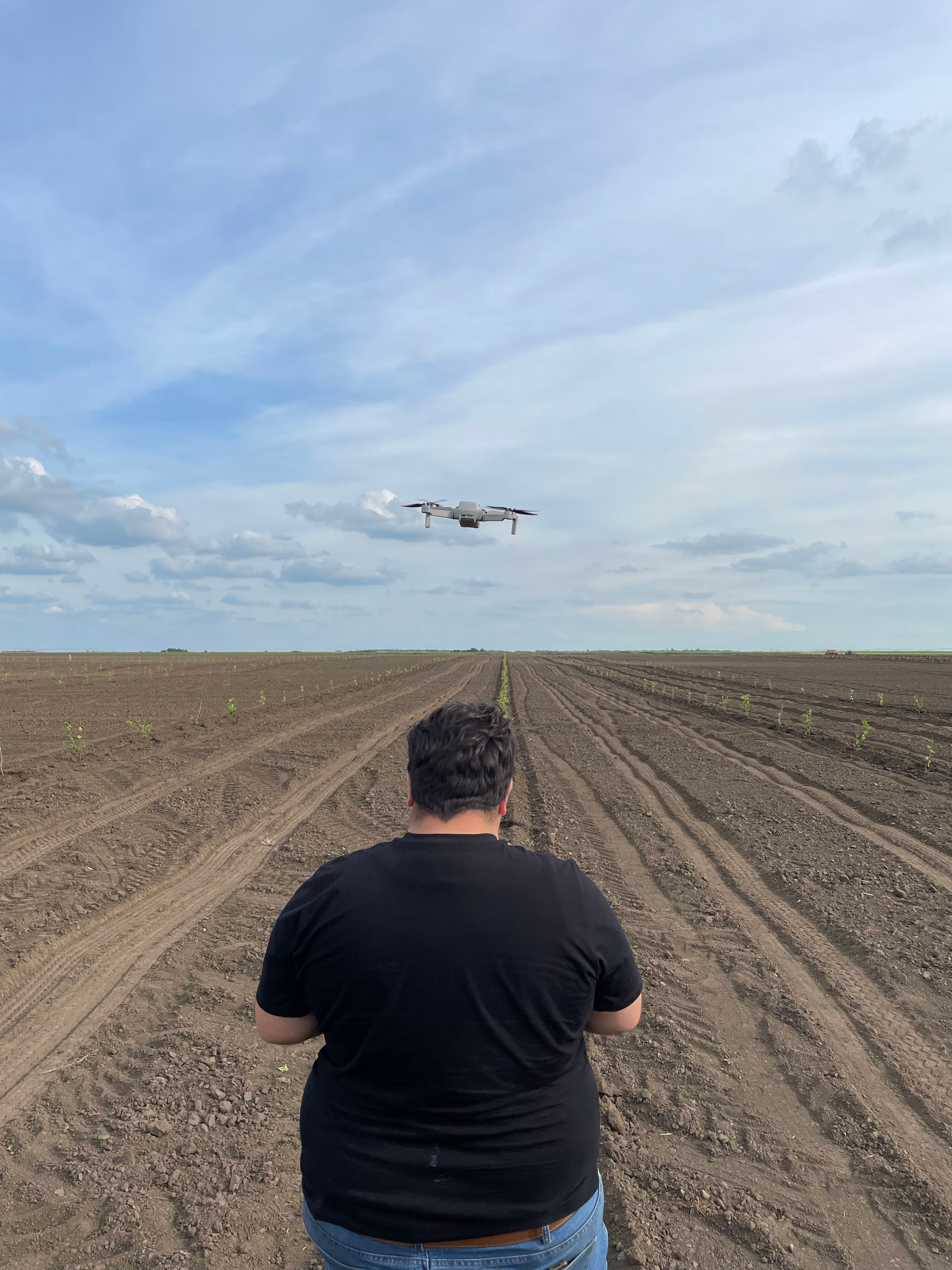
Instead of uniform field applications, Treesury divides orchards into dynamic management zones using Sentinel-2 multispectral satellite imagery, vegetation indices (NDVI), and drone passes. Subsurface probes track moisture levels, atmospheric pressure, and sap flow in real time. These inputs trigger automated micro-drip irrigation and organic nutrient injection directly to the root zone, reducing overall water and fertilizer usage by approximately 10 percent.
Mechanized Execution and Superior Yield Curves
Topography dictates harvest efficiency. Treesury anchors new commercial developments, such as its 106-hectare site in Čoka, on flat, laser-graded plots located near major transport corridors (Class 105 IIA road, 32 km from the A1-IA highway). Unlike legacy manual systems, ripe hazelnuts naturally drop to bare orchard floors and are harvested using high-capacity, tractor-mounted mechanical sweepers. This mechanization drastically lowers per-hectare labor expenditure and eliminates operational bottlenecks.
Through precise fertigation, elite rootstocks (Tonda di Giffoni, Tonda Gentile), and mechanized recovery, Treesury achieves average yields exceeding 4.0 tons per hectare, with top-performing test plots generating up to 5.5 tons per hectare. This verified production baseline creates a reliable, high-volume supply pipeline engineered specifically for tier-one industrial processors like Ferrero.
References
- Fact.MR (2025). Hazelnut Market Outlook: Global Industry Analysis and Forecast (2025–2035).
- Rainforest Alliance (2024). Certified Hazelnuts: Tackling Supply Chain and Labor Vulnerabilities in the Mediterranean.
- Gürsoy A.Ş. Technical Research (2024). Nutritional Composition, Fatty Acid Profiles, and Industrial Applications of Hazelnut Lipids.
- Food and Agriculture Organization (FAO). Global Crop Statistics & Production Concentration Datasets.
by Treesury Investment Team