
Why does a 10-year fund clock sit badly with a permanent crop?
Because the closed-end fund was designed to buy, improve and sell operating companies within a decade, and its economics depend on returning capital on that schedule. A permanent crop does not improve on a ten-year schedule. It spends its first years consuming capital and its following decades producing it, so a structure that must sell at year ten is forced to sell at the point where the asset has only just repaid investors’ initial investment and begun to pay full dividends. The conventional private equity fund has a stated life of ten years, typically with the option of one-year extensions, and is organised around an investment period followed by a harvest period in which assets are sold and capital returned (Callan, 2020). The general partner’s carried interest, the investors’ internal rate of return and the fund’s ability to raise its successor all reward early, visible exits. None of this is a defect when the underlying asset is a company that can be refinanced, recapitalised or sold to a strategic buyer at any point in its life. The evidence suggests the ten-year clock is a fiction even in conventional buyouts. In data on 372 US private equity funds from Adams Street Partners, about 92% were still holding assets beyond year ten, roughly 81% beyond year twelve and about 46% beyond year fifteen. Across a larger Pitchbook sample, the median fund still held 0.47 times its paid-in capital in unrealized value at year ten (Upwelling Capital Group, 2019, sector evidence). Funds that outlive their term create pressure on both sides of the table. Investors want liquidity they were promised, and managers face a choice between selling into whatever market exists or transferring the asset to a new vehicle they also manage. That second route has become an industry of its own. Secondary market volume reached a record US$240 billion in 2025, up 48% on the prior year, with buyout GP-led transactions, most of them continuation vehicles, rising from US$58 billion to US$81 billion (Ropes & Gray, 2026, citing Campbell Lutyens, Evercore, Jefferies and PJT). A continuation vehicle lets a manager hold an asset beyond the fund’s life by selling it from one of its own funds to another, which solves the timing problem at the cost of a conflict of interest, because the manager sits on both sides of the price. The scale of that market is, in effect, a measure of how often the ten-year clock and the asset’s natural holding period disagree. Long-dated private equity funds, with terms of 15 years or more and sometimes no fixed term, exist precisely to address this. They tend to target lower internal rates of return in exchange for compounding, and charge lower annual fees over a longer period, which can leave total lifetime fees equal to or above those of a conventional fund (Callan, 2020). The trade-off is instructive. Matching the vehicle to the asset is not free, and a family office that treats a longer term as purely an advantage has not priced the illiquidity it accepts.
What does a forced exit at year ten actually sell?
It sells an orchard that has only just reached full production, together with almost all of the output it will ever produce. On the whitepaper’s forecast schedule, a hectare yields nothing in years one to three, reaches its full forecast level in year nine, and is planned to produce for 40 years. A seller at year ten has borne the entire establishment phase and hands the mature phase to the buyer.
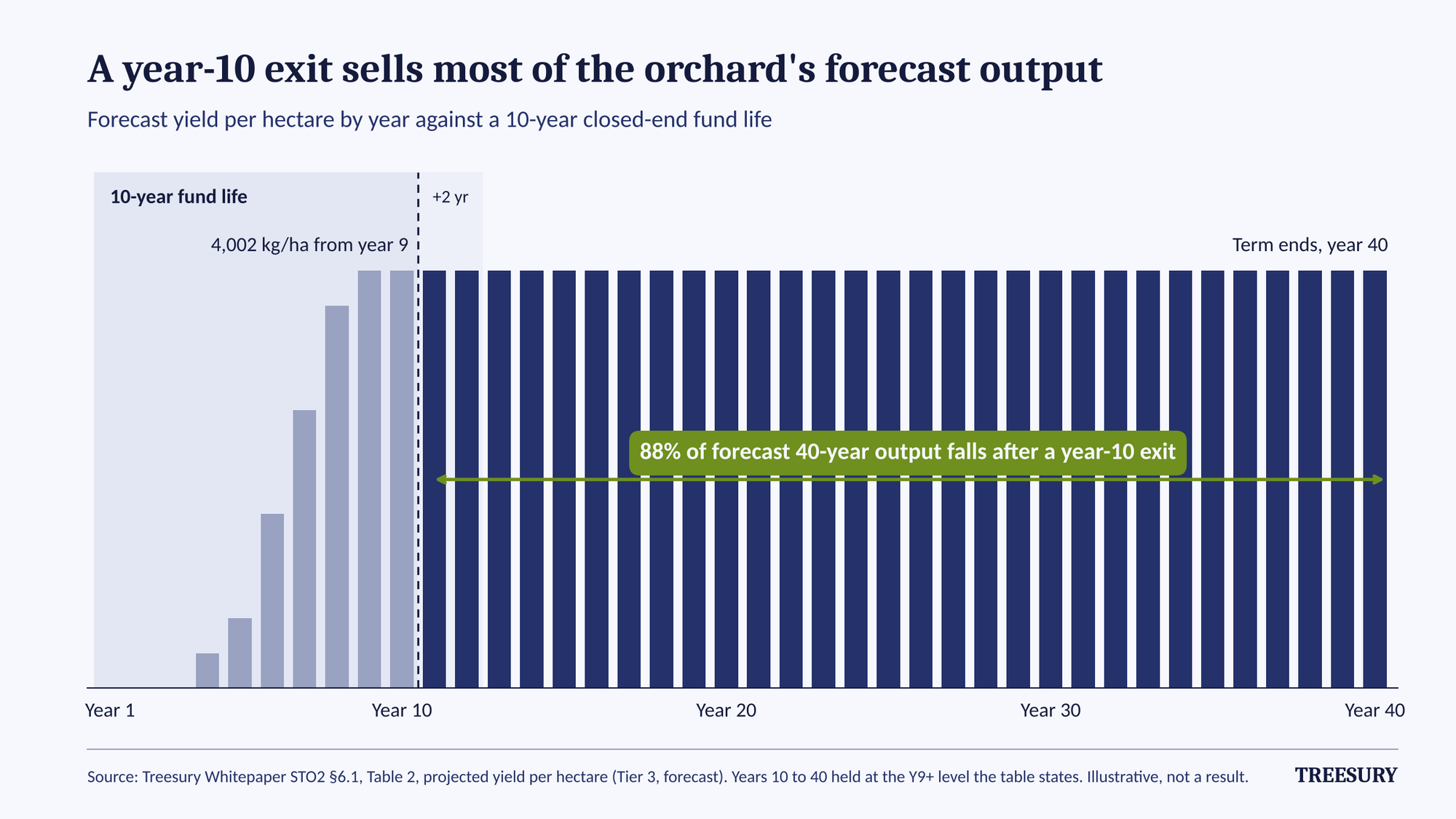
Forecast yield per hectare by year against a 10-year fund life
The forecast schedule is not peculiar to this orchard. A 2022 Oregon State University budget for Willamette Valley hazelnuts assumes full production is reached eleven to twelve years after planting and sustained for 25 years thereafter (Wiman et al., 2022, sector evidence). In both cases the shape is the same: a decade of capital consumption, followed by decades of production. A buyer at year ten prices that tail at their own cost of capital and captures it. The seller’s return is then set less by how well the orchard was established than by the price available in the month the fund must sell. That price is not stable. On the main US farmland index, permanent cropland appraisals fell 8.48% in 2025 alone (AgIS Capital, 2026, reporting NCREIF data, sector evidence), and a fund at the end of its term has limited ability to wait for a better market. The architecture of the orchard compounds the point: planting density, thinning by year seven and row spacing are fixed for its whole life, so the value a fund creates in its first decade is largely the option on production that only a long-horizon holder will exercise. The chart assumes yield holds flat at the year-nine level to the end of the term, as the whitepaper’s table implies. Real orchards vary year to year and decline with age, and the share shown is illustrative arithmetic on a forecast, not an outcome.
How is the market solving the duration problem?
By removing the fixed exit date, in at least seven different ways, each of which moves the cost of long duration somewhere else. Nobody has eliminated that cost. The allocator’s real choice is which version to carry: illiquidity, a landlord’s rent instead of crop upside, a manager’s discretion over redemptions, or a tax wrapper that works in one jurisdiction only. The cautionary precedent is timber. In the 1990s many timberland investment management organizations raised capital on a model in which a fund was operated for ten years and then given five years to sell its land. Clark Binkley, a former timber investment executive and academic, described the model in 2007 as unsustainable, because exits forced land into parcels the managers themselves could not buy, and because around a third of income for these owners came from real-estate sales rather than timber (Binkley, 2007, sector evidence). Timber rotations are longer than an orchard’s productive ramp, but the lesson transfers. A fixed exit sells on the fund’s calendar, not the asset’s.
| Model | Example | How the duration problem is handled | What the investor gives up |
|---|---|---|---|
| Closed-end fund with a fixed term | 1990s timberland funds, most conventional private equity and farmland funds | A fixed exit, then extensions or a continuation vehicle when the asset is not ready | Exit timing set by the fund calendar, and conflicts when the manager sells to itself |
| Open-end fund and perpetual private REIT | Nuveen’s open-end farmland fund (US$464 million raised by February 2020) and its perpetual-life private farmland REIT, priced monthly at NAV | No terminal date. Investors enter and leave at appraised value | Liquidity depends on redemption capacity, and returns are marked by appraisal and exposed to valuation cycles |
| Listed agricultural landlord | Rural Funds Group (ASX: RFF), weighted average lease expiry of 13.9 years with about 80% of forecast income from corporate and institutional lessees, including a 1,500-hectare almond orchard developed for lease to Olam (2015) | The tenant carries crop risk on long leases. The investor owns a share of the landlord | Daily price volatility unrelated to the orchards, rent instead of crop upside, and tenant concentration |
| Evergreen wealth-channel fund | FarmTogether Sustainable Farmland Fund, open-end and evergreen, concentrated in permanent crops, US$50,000 minimum | The fund buys and holds, and investors redeem under fund rules | Manager discretion over liquidity and fee drag over a long hold |
| Fractional title to an orchard | Farmfolio, Colombia, tenants-in-common lots of US$30,000 to US$60,000 in lime and coconut orchards, transferable for a 3% fee | Direct land ownership, with exit by selling the lot | A buyer must be found case by case, and operating and country risk is carried directly |
| Statutory family vehicle | French vineyard and farmland groupings (GFV and GFA), leased long-term to operators | Built to be inherited: 75% transfer-tax relief up to €300,000 per beneficiary and 50% above, with minimum holding periods | Low current yield, often partly in kind, low liquidity and a horizon often of 8 to 15 years or more. France only |
| Production-linked instrument | Treesury, Serbia | Instrument term set to the tree’s commercial life, repaid from production | Period without distribution until crop yields |
Sources: Binkley (2007), Global AgInvesting (2025, 2018), Agri Investor (2020, 2015), Rural Funds Group FY25 results (22 August 2025), FarmTogether (31 March 2026), Benzinga (2025), Hayot Expertise (2025). Figures are as reported by each source
Three patterns stand out. The first is that the dividing line is not technology or geography but who carries the timing risk. In closed-end and open-end funds the investor carries it, through the exit market or the NAV. In the listed landlord and the French groupings it is pushed onto a tenant under a long lease. In the strategic owner it disappears, because the owner never intends to sell. The second is convergence on perpetual life. Nuveen has moved from an open-end institutional fund to a perpetual REIT with a broader investor base, and WisdomTree, an asset manager with its own tokenized fund platform, agreed in 2025 to acquire US farmland manager Ceres Partners (Global AgInvesting, 2025). Promises of liquidity are reaching the asset class faster than the asset class itself is becoming liquid. The third is that no model yet delivers both duration and liquidity at the value of the underlying orchards. Where liquidity exists, it comes from a public market that prices the landlord rather than the trees, from a redemption mechanism the manager can gate, or from a buyer found case by case. Tokenized farmland has so far published little secondary trading evidence. A September 2025 article advocating the approach, written by the founder of a farmland platform, cited no completed trades or volumes (Milinchuk, 2025). Any long-duration agricultural product’s liquidity claim should be treated as untested until it shows trades. In Serbian hazelnut specifically, the category is still forming and the dominant model is none of the above. It is a buyer-led supply program. Serbia had 8,718 hectares of hazelnut orchards in 2024, Ferrero reports having distributed more than 1.8 million saplings and supporting 3,360 hectares of new orchards across 680 farming households, and a government plan aims to raise annual output from 9,000 to 40,000 tonnes over ten years (FreshPlaza, October 2025). Capital in this market has so far followed the buyer’s supply strategy rather than an investor’s duration preference, which is the gap investable long-horizon structures are trying to fill.
How do multi-decade structures fit intergenerational capital, and what do they cost?
They fit capital whose horizon is measured in generations rather than fund cycles, and they cost liquidity. The same feature that protects the asset from a forced sale also prevents the investor from forcing one, so the match is only an advantage for capital that will not need to leave. The pool of capital with a genuinely multi-decade horizon is large and growing. Cerulli Associates projects that US$124 trillion in wealth will transfer in the United States through 2048, of which US$105 trillion is expected to pass to heirs (Cerulli Associates, 2024, as reported by NAPA-Net). Family offices managing that transition frequently describe their objective as preserving purchasing power across generations rather than maximising a ten-year internal rate of return, and for that objective the relevant questions are different. How does the asset pass to an heir? What does it produce while it is held? Does its value depend on a sale at a particular moment? A multi-decade production instrument answers those questions in a particular way. Return comes from annual harvest income over the asset’s productive life rather than from a terminal sale, so its value does not depend on the exit market in any given year. That cuts both ways. It removes the risk of being forced to sell into a weak market, which matters in a sector where the main US permanent cropland index has trailed annual cropland on total return for six consecutive years, returning negative 5.43% in 2025, with income at 3.24% and appraised values down 8.48% (AgIS Capital, 2026, reporting NCREIF data, sector evidence). It also removes the investor’s ability to realize value through a sale at a moment of their choosing.
Where does Treesury sit?
t the long, illiquid end of the spectrum above. Treesury holds an approximately 106-hectare, 40-year lease in Čoka, Serbia (Tier 1, actual), and investors hold a 40-year instrument repaid from the funded orchard’s production rather than an interest in land, with no fixed exit date and no fixed repayment period (Whitepaper §7.2, §7.3). The first offering raised €1.5 million and planted 53 hectares (Tier 1). The orchard has not yet produced and first payouts are forecast for March 2033 (Tier 3). There is no live secondary market for the new instruments yet, although Treesury platform supports token trading between the current token owners and any accredited investors registered on Treesury platform or any other platform that uses ONCHAIN ID.
What this analysis does not tell you
It does not show that a 40-year structure produces higher returns than a private equity fund. The argument is about avoiding value leakage from forced timing. No realized return exists for this structure, and the comparison would in any case depend on the specific fund, vintage and manager. It does not compare the realized returns of the models in the landscape table. Their reporting bases differ, from listed prices to appraisal-based NAVs to no periodic valuation at all, and the table describes structure, not performance. What happens to trees and improvements when a lease-based structure ends also varies by contract and should be read in full for any vehicle under consideration. It does not quantify the cost of illiquidity, which depends on each investor’s own need for capital over the holding period. It does not address counterparty risk over four decades, including the continuity of the Issuer, the lessor and the regulatory framework. These are treated in the governance and investor rights material. Where a figure could not be traced to the approved whitepaper or to a named and dated external source, it has been omitted rather than approximated.
Frequently asked questions
Is a 40-year term simply a way of avoiding accountability for returns?+
It can be, which is why the question is fair. The counterweight is reporting. A long-duration manager should publish projected against actual production and earnings every season, so that performance is visible long before the term ends. Without that, a long term deserves scepticism.
Can a closed-end fund not simply hold the orchard through a continuation vehicle?+
It can, and many funds now do something similar with other assets. The cost is a transaction in which the manager sits on both sides of the price, plus fees on the new vehicle. A structure that matches the asset from the start avoids that transaction, though not the other costs of long duration.
Why lease rather than own the land?+
Leasing reduces the capital required per hectare and separates the production return from farmland valuation, which has been volatile for permanent crops in recent years. It also means investors do not participate in any appreciation of the land. Both effects follow from the same choice.
Who is this structure not for?+
Any investor who may need the capital back within ten years, or who is seeking exposure to land values rather than to production. For those investors, the features described here are costs rather than benefits.
How can a holding of this length pass to the next generation?+
Through the vehicle’s own transfer rules, which differ widely. French land groupings are designed for it and carry statutory transfer-tax relief. Listed landlords pass like any listed share. Private funds and digital instruments typically permit gift and inheritance subject to identity checks and transfer restrictions. Estate and tax treatment depends on the domicile of the holder and the heir, and should be confirmed with advisers in each jurisdiction.
References
- Treesury Whitepaper STO2 (English certified translation), §3.3.1 p. 22 and §5 p. 41, orchard location and leased area of approximately 106 hectares over 40 years.
- Ibid., §1 p. 6 and §4.3 p. 37, first offering, €1.5 million raised and 53 hectares planted.
- Ibid., §7 p. 51, §7.2 pp. 52 to 54 and §7.3 p. 55, instrument character, 40-year duration, revenue allocation and first payouts.
- Ibid., §6.1, Table 2, p. 46, projected physical yield per hectare by year (forecast).
- Ibid., §10.2.3 p. 82, §10.3.1 pp. 83 to 84, §10.7.3 pp. 89 to 90 and §10.8 p. 91, land contingency, production-dependent returns, secondary market immaturity and absence of investor protection.
- Upwelling Capital Group (2019). Tail-End Research Report, Q2 2019. Adams Street Partners data on 372 US private equity funds and Pitchbook residual value data.
- Kahn, A. (2020). Long-dated private equity funds: key considerations for investors. Callan, 16 January 2020.
- Ropes & Gray (2026). Secondaries update, full year 2025, citing Campbell Lutyens, Evercore, Jefferies and PJT.
- Cerulli Associates (2024). U.S. High-Net-Worth and Ultra-High-Net-Worth Markets 2024, as reported in NAPA-Net, 30 December 2024.
- AgIS Capital (2026). State of Returns, 6 March 2026, reporting NCREIF Farmland Property Index data.
- Wiman, N., Miller, M. and Seavert, C. (2022). Orchard economics: hazelnuts on standard-density and double-density systems in the Willamette Valley. Oregon State University, AEB 0068.
- Binkley, C. S. (2007). The rise and fall of the timber investment management organizations. Pinchot Distinguished Lecture, 2 March 2007.
- Global AgInvesting (2025). Nuveen launches private farmland REIT with exposure to California’s Central Valley, 24 September 2025. Agri Investor (2020). Nuveen’s open-end farmland fund takes in $464m, 7 February 2020.
- Rural Funds Group (2025). FY25 results release, ASX, 22 August 2025.
- Agri Investor (2015). Rural Funds Group and Olam ink new almond deal, 22 September 2015.
- FarmTogether (2026). Sustainable Farmland Fund delivers third consecutive year of benchmark outperformance, 31 March 2026 (manager’s own release).
- Benzinga (2025). Farmfolio review, 29 May 2025.
- Hayot Expertise (2025). Land groupings (forestry, wine): diversifying and transferring, 2026 taxation, October 2025.
- FreshPlaza (2025). Serbia develops hazelnut excellence district, 28 October 2025.
- Milinchuk, A. (2025). Tokenization and farmland: unlocking liquidity in a scarce asset class. Global AgInvesting, 4 September 2025.
by Treesury Investment Team